
Performance Review · People Development Cycle
A design case study from the AI HR capability: employees update evidence, managers review, HR coordinates calibration and employees respond to results.
An AI HR landing and Performance Analytics direction exist; the review system, assistant and apps in this kit are proposed prototypes using no real HR data.
Sample UIs use synthetic data. Existing DocAgent screenshots have record/partner/figure data redacted. No real customer or employee results are used for illustration.
Goals
Publish criteria, weights and permissions before the cycle.
Evidence
Employees update work and self-review.
Review
Managers check against the rubric and write evidence-based comments.
Calibration
HR checks consistency, coordinates and publishes within rights.
Development
Employees respond; actions and coaching milestones are agreed.
See where the work gets done.
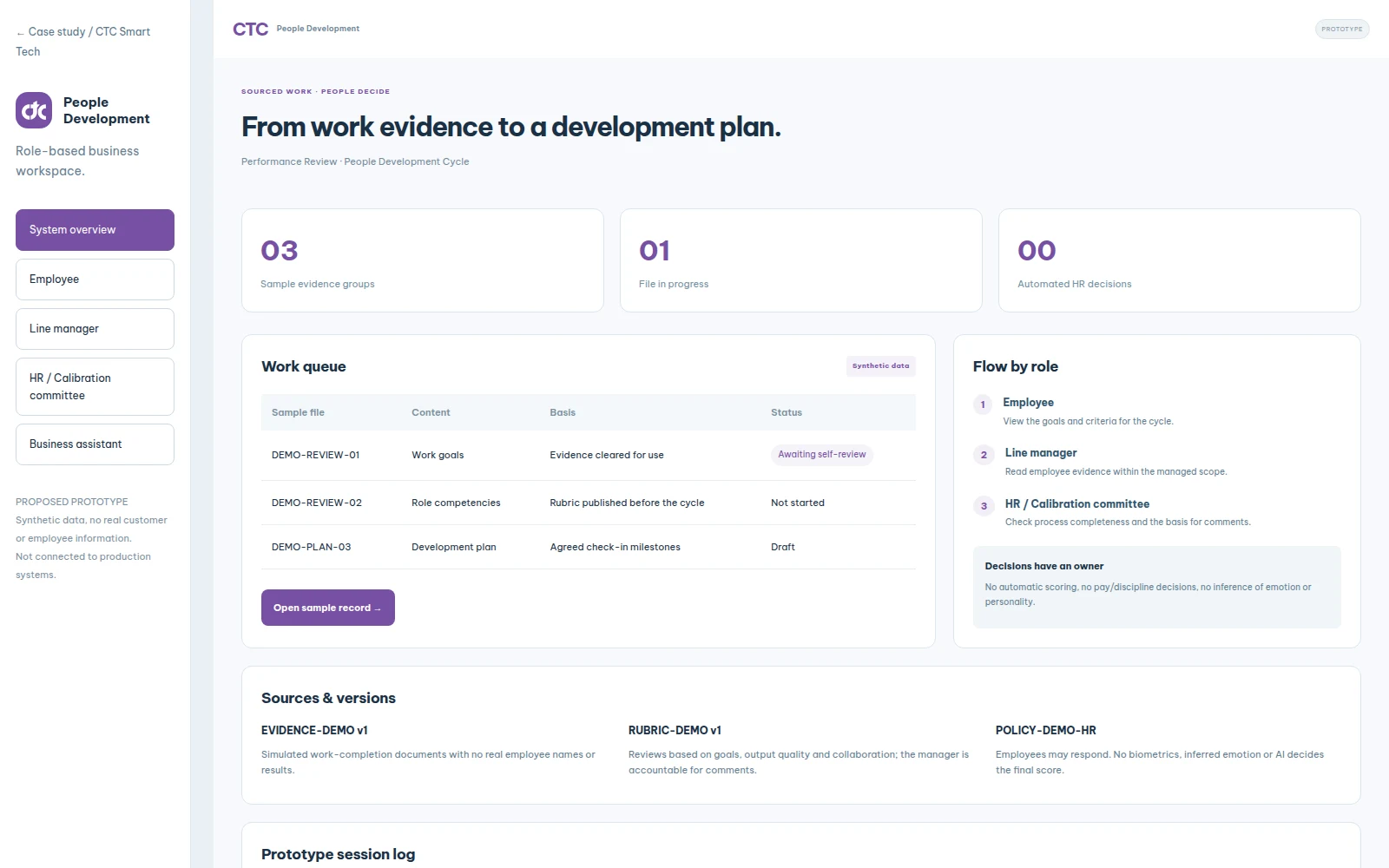
People Development workspace
Prototype dashboard with simulated records; states and process follow the solution design.
Open the sample UI ↗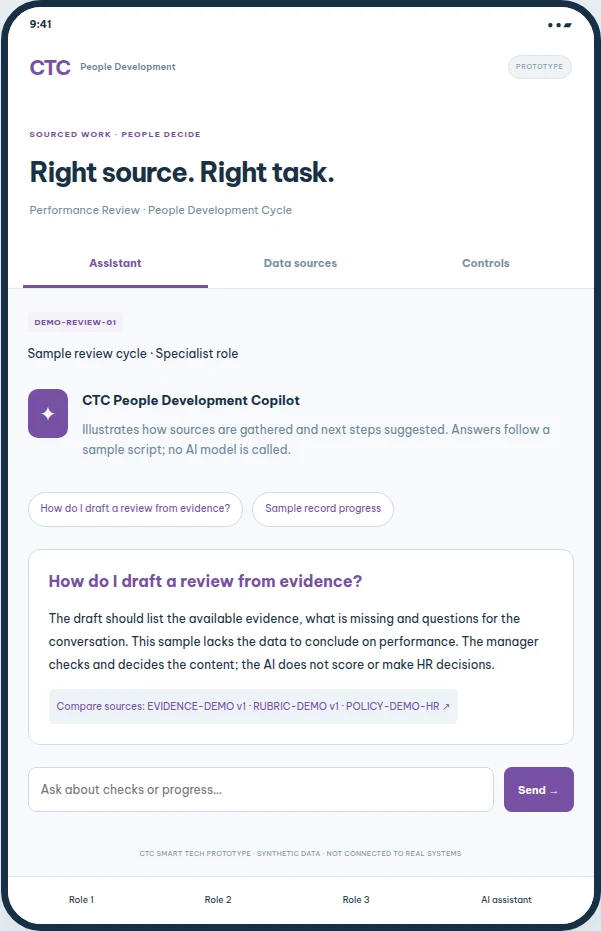
People Development assistant
How do I draft a review from evidence? Sourced simulated scenario; no LLM call.
Open the sample UI ↗Every role has a clear workflow.
The apps focus on frequent tasks. In production they share the APIs, file codes, permission policy and history of the business platform.
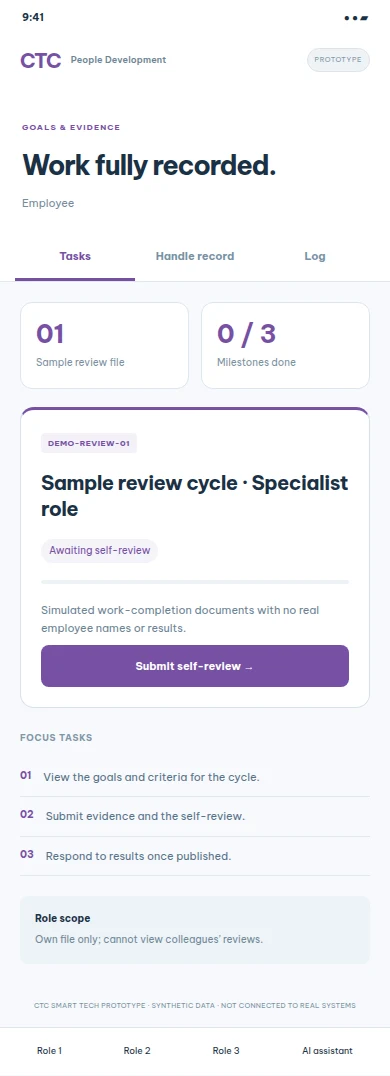 GOALS & EVIDENCE
Employee
- View the goals and criteria for the cycle.
- Submit evidence and the self-review.
- Respond to results once published.
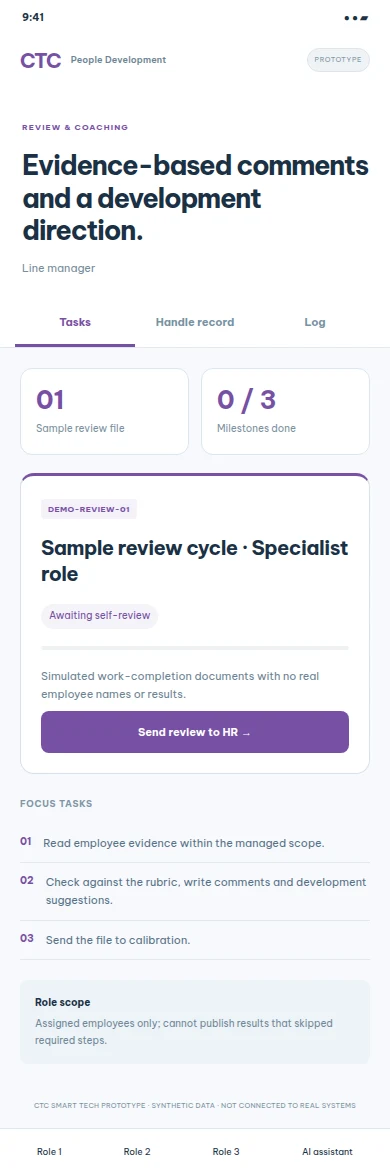 REVIEW & COACHING
Line manager
- Read employee evidence within the managed scope.
- Check against the rubric, write comments and development suggestions.
- Send the file to calibration.
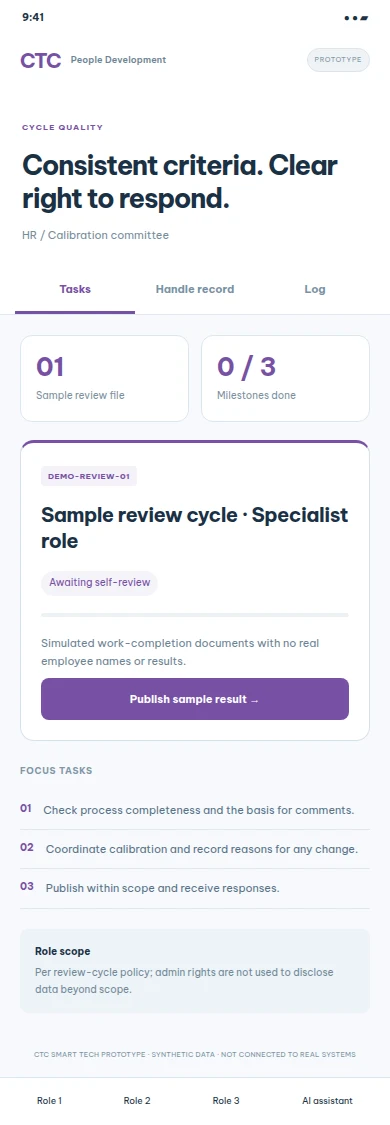 CYCLE QUALITY
HR / Calibration committee
- Check process completeness and the basis for comments.
- Coordinate calibration and record reasons for any change.
- Publish within scope and receive responses.
Module mapping & permission limits
| Role | Module | Scope |
|---|---|---|
| Employee | Goals → Evidence → Self-review → Response | Own file only; cannot view colleagues’ reviews. |
| Line manager | Evidence → Review → Development plan | Assigned employees only; cannot publish results that skipped required steps. |
| HR / Calibration committee | Progress → Calibration → Publish → Response | Per review-cycle policy; admin rights are not used to disclose data beyond scope. |
From input to an evidence-based decision.
The first role completes the checklist and submits evidence; the next role records an evidence-based result; the approver confirms or returns with a reason. The sample session logs every step.
After HR publishes the sample result, the employee can respond into the same history. There is no automatic scoring and no pay/discipline decision.
No automatic scoring, no pay/discipline decisions, no inference of emotion or personality.
Sample state is stored in the same browser, separated per solution. There is no authentication, multi-user backend, cross-device sync, push or LLM connection. Those must be built and accepted before real operation.
Sources to compare, not automatic conclusions.
EVIDENCE-DEMO v1
Simulated work-completion documents with no real employee names or results.
RUBRIC-DEMO v1
Reviews based on goals, output quality and collaboration; the manager is accountable for comments.
POLICY-DEMO-HR
Employees may respond. No biometrics, inferred emotion or AI decides the final score.
The draft should list the available evidence, what is missing and questions for the conversation. This sample lacks the data to conclude on performance. The manager checks and decides the content; the AI does not score or make HR decisions.
DEMO sources are synthetic data for simulation. Real business documents must be collected with usage rights, versioned and quality-checked.
Pilot & acceptance roadmap
- Choose one position group; agree the rubric and access policy.
- Build a cleared evidence set and the review forms.
- Run a trial cycle with three roles, calibration and responses.
- Accept access rights, review basis and development actions.
Conditions to verify
- Submission only when the self-review has evidence and a complete checklist.
- Reviews are evidence-based before HR publishes.
- Employees can respond within their own file.
- No automated decisions on scores, pay or discipline.
Agree scope, baseline, sample size, confirming person and operating responsibility before the pilot. Demos do not replace acceptance results or performance commitments.
Reference direction: CTC Smart Tech AI HR & Performance Analytics direction. Details are compiled from existing documents and source code; new UIs are clearly marked as proposed designs.