
Industrial IoT · Plant Operations
A design case study based on the Industrial IoT and CPSmart profile: monitoring measurement points, verifying alerts, assigning maintenance and closing the loop.
IoT/CPSmart capability documentation exists; the dashboards, assistant and apps in this kit are design prototypes not connected to real equipment.
Sample UIs use synthetic data. Existing DocAgent screenshots have record/partner/figure data redacted. No real customer or employee results are used for illustration.
Collect
Log timestamp, equipment, measurement point and signal quality.
Verify
Operations receives the alert and checks data reliability.
Assign
Create an inspection request for the right technician.
Maintain
Record the checklist, on-site result and evidence of work.
Close the loop
The manager checks the result before closing the alert.
See where the work gets done.
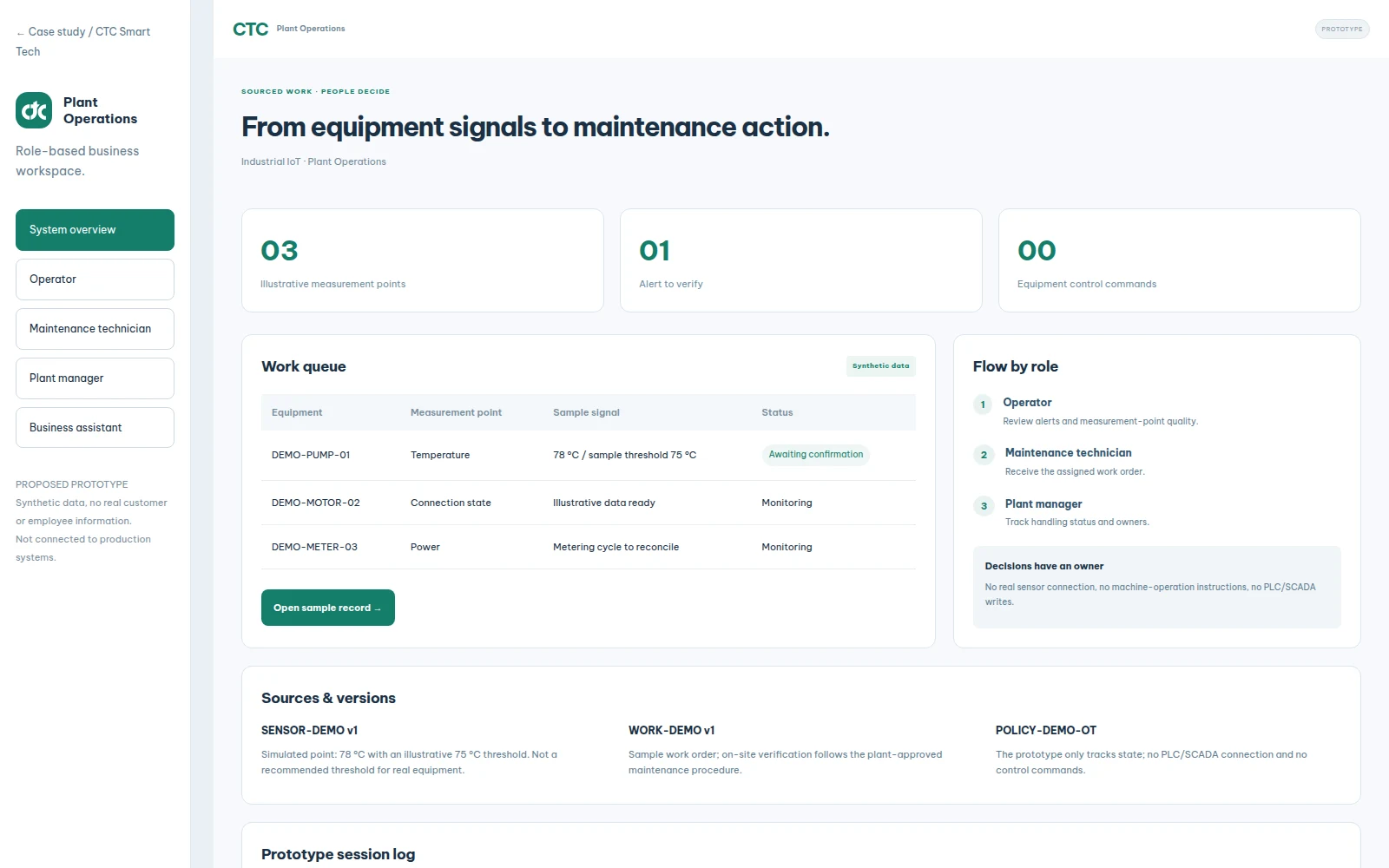
Plant Operations workspace
Prototype dashboard with simulated records; states and process follow the solution design.
Open the sample UI ↗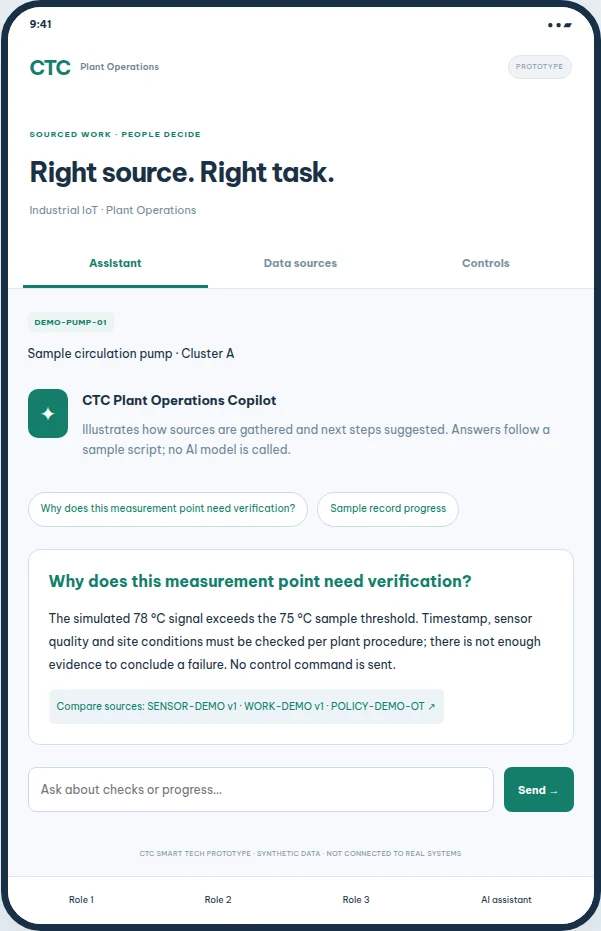
Plant Operations assistant
Why does this measurement point need verification? Sourced simulated scenario; no LLM call.
Open the sample UI ↗Every role has a clear workflow.
The apps focus on frequent tasks. In production they share the APIs, file codes, permission policy and history of the business platform.
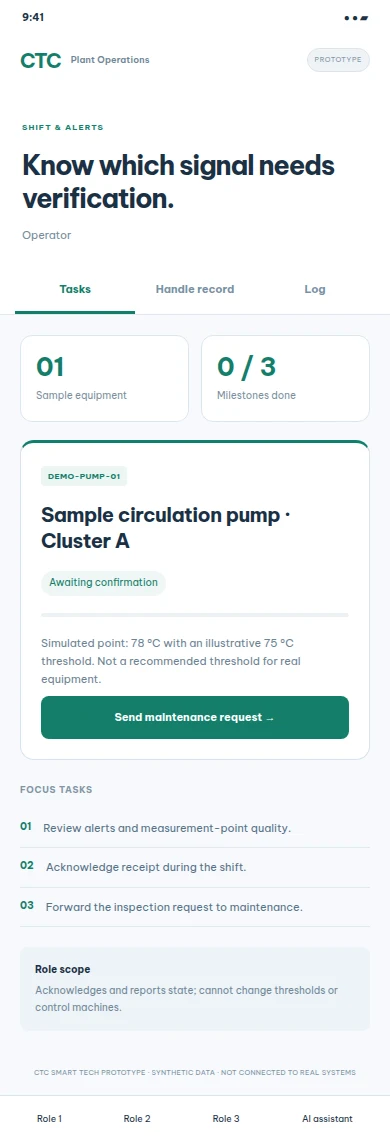 SHIFT & ALERTS
Operator
- Review alerts and measurement-point quality.
- Acknowledge receipt during the shift.
- Forward the inspection request to maintenance.
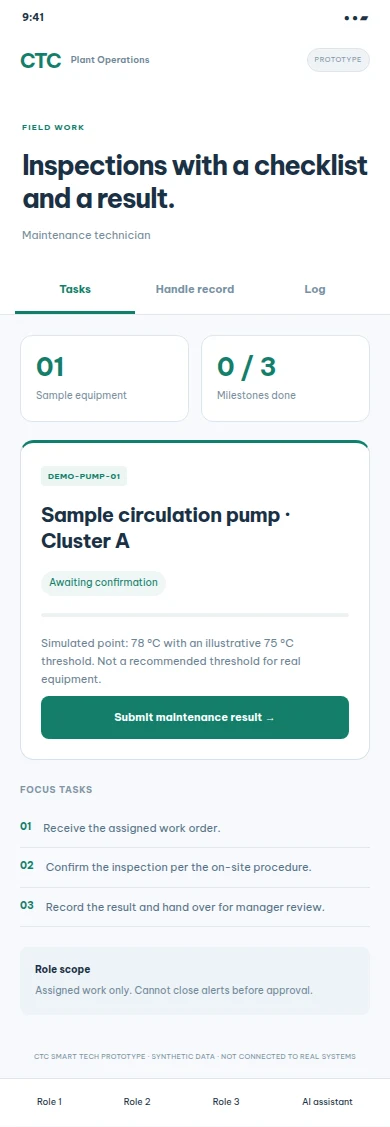 FIELD WORK
Maintenance technician
- Receive the assigned work order.
- Confirm the inspection per the on-site procedure.
- Record the result and hand over for manager review.
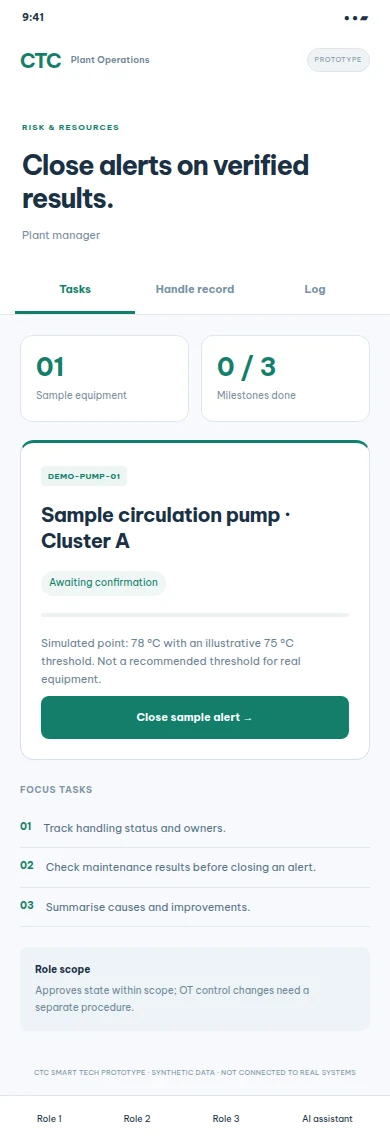 RISK & RESOURCES
Plant manager
- Track handling status and owners.
- Check maintenance results before closing an alert.
- Summarise causes and improvements.
Module mapping & permission limits
| Role | Module | Scope |
|---|---|---|
| Operator | Monitoring → Alerts → Maintenance request | Acknowledges and reports state; cannot change thresholds or control machines. |
| Maintenance technician | Work order → Checklist → Inspection result | Assigned work only. Cannot close alerts before approval. |
| Plant manager | Dashboard → Maintenance → Close approval → Audit log | Approves state within scope; OT control changes need a separate procedure. |
From input to an evidence-based decision.
The first role completes the checklist and submits evidence; the next role records an evidence-based result; the approver confirms or returns with a reason. The sample session logs every step.
No real sensor connection, no machine-operation instructions, no PLC/SCADA writes.
Sample state is stored in the same browser, separated per solution. There is no authentication, multi-user backend, cross-device sync, push or LLM connection. Those must be built and accepted before real operation.
Sources to compare, not automatic conclusions.
SENSOR-DEMO v1
Simulated point: 78 °C with an illustrative 75 °C threshold. Not a recommended threshold for real equipment.
WORK-DEMO v1
Sample work order; on-site verification follows the plant-approved maintenance procedure.
POLICY-DEMO-OT
The prototype only tracks state; no PLC/SCADA connection and no control commands.
The simulated 78 °C signal exceeds the 75 °C sample threshold. Timestamp, sensor quality and site conditions must be checked per plant procedure; there is not enough evidence to conclude a failure. No control command is sent.
DEMO sources are synthetic data for simulation. Real business documents must be collected with usage rights, versioned and quality-checked.
Pilot & acceptance roadmap
- Survey measurement points, protocols and the OT/IT boundary.
- Connect read-only; check timestamps, missing data and buffering.
- Run trial alerts; cross-check with operations/maintenance.
- Accept the confirm–handle–close loop and recovery capability.
Conditions to verify
- Alerts store source, time and measurement-point quality.
- No closing without an inspection result.
- Delayed / disconnected data shows the correct state.
- The monitoring flow never generates control commands.
Agree scope, baseline, sample size, confirming person and operating responsibility before the pilot. Demos do not replace acceptance results or performance commitments.
Reference direction: CTC Smart Tech Industrial IoT & CPSmart capability profile. Details are compiled from existing documents and source code; new UIs are clearly marked as proposed designs.